Flare Gas Recovery
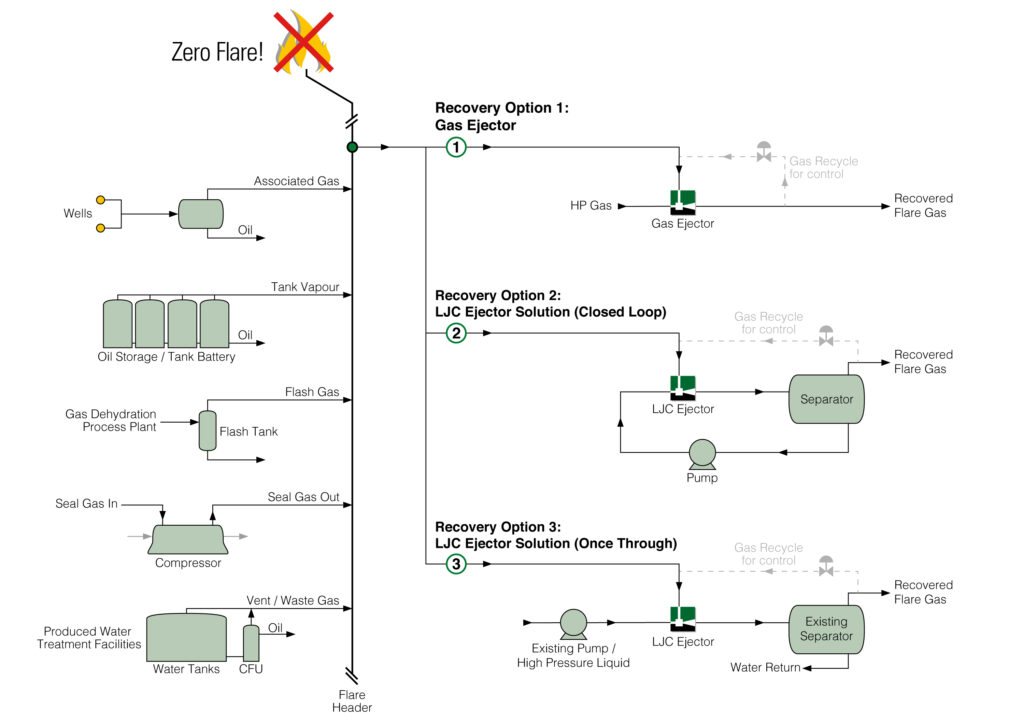
Flare Gas Recovery Overview
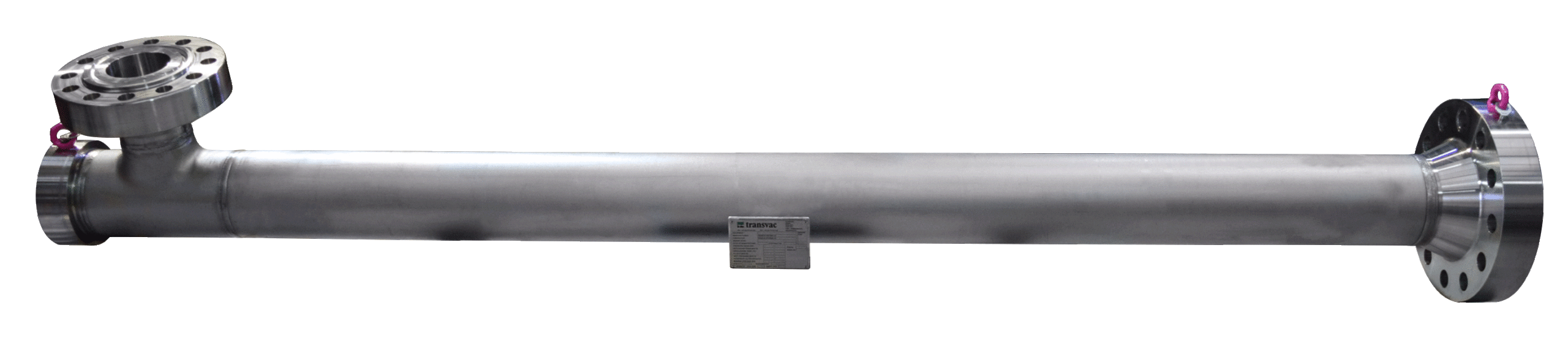
Transvac's unique Flare Gas Recovery Ejectors are a proven solution to reduce (or even eliminate) carbon emissions from widespread routine flaring and to usefully use waste gas, thereby saving energy. ZIRCO is proud to represent Transvac as the authorized distributor for Western Canada.
Environmental Impact: Thousands of gas flares at oil production sites around the globe burn approximately 140 billion cubic meters of natural gas annually, causing more than 300 million tons of CO2 to be emitted to the atmosphere (The World Bank).
Due to environmental and legislative pressures, Operators are now looking to address the problem of flaring, with many committing to 'Zero Routine Flaring' initiatives. Transvac's Ejector technology provides proven, reliable, cost-effective Flare Gas Recovery solutions to tackle greenhouse gas emissions.
Why Choose Ejector Technology?
Zero Moving Parts
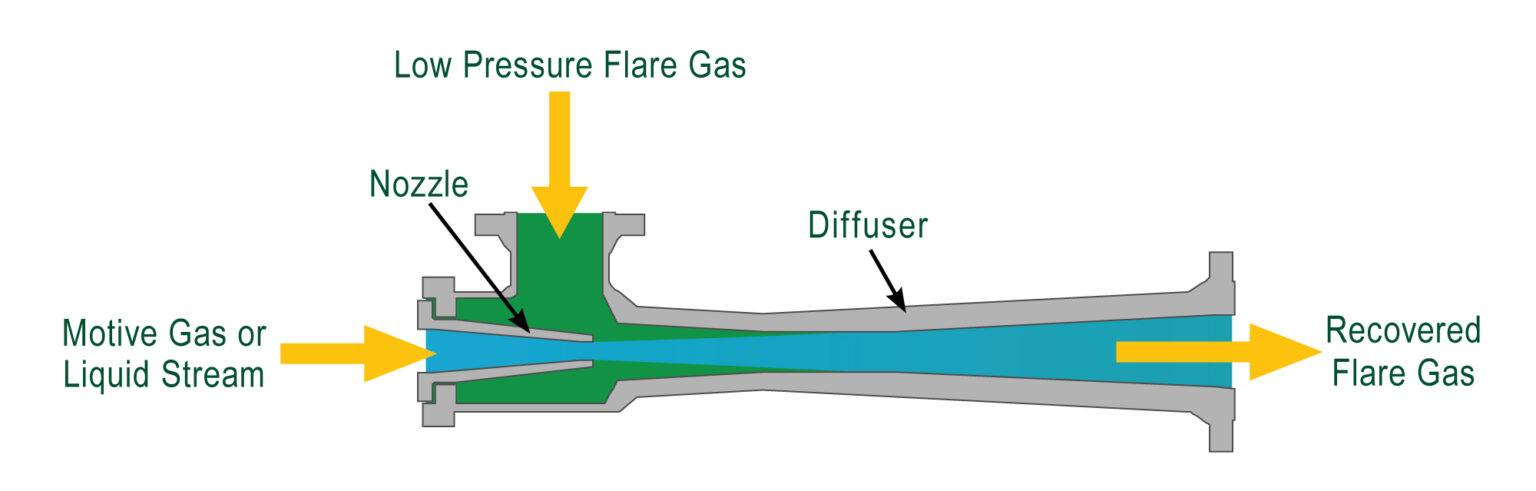
Ejectors are static, pipework-based compressors. They have no moving parts, require zero maintenance, and can be installed like regular pipework.
Cost Effective
Simple design makes Ejectors very cost effective compared to traditional compressors, with minimal CAPEX and OPEX requirements.
Zero Energy Input
Ejectors can utilize existing or waste gas/liquid streams to operate. No new energy required when high-pressure motive is available.
Technical Specifications & Design Considerations
How to Use Ejectors for Flare Gas Recovery
Ejectors can be configured in a number of ways for Flare Gas Recovery, depending upon the process requirement and availability of existing facilities at each respective site. When considering an Ejector project, it is first important to establish the following:
- The maximum Flare Gas flow rate - to define the required capacity of the Ejector solution
- A desirable recovery point/destination - for the flare gas to be sent after compression through the Ejector. This determines the discharge pressure the Ejector must achieve. Typically, gas is returned to the production process at a suitable point such as a separator inlet, used as a fuel gas, or is sent down-hole
- If an existing motive gas or liquid stream is available - (and is sufficient) to provide the motive stream to the Ejector. If not, a system can be provided which includes a dedicated pump and other associated equipment, as required
- Composition of the Flare Gas (and motive) stream - considered as part of the process and mechanical design, but also ensures a suitable material of construction is selected. Transvac can manufacture Ejectors from a wide range of standard and exotic materials to suit challenging, sour service projects
- Modes of operation and control requirements - some projects have defined modes of operation due to seasonal changes in process requirements, which can affect flare gas flow rates
High Efficiency Liquid Motivated Ejectors
| Feature | Specification |
|---|---|
| High Discharge Pressure | Can compress flare gas from 0 to 2150 psig in a single stage |
| Multi-stage Capability | Multiple stages for higher compression requirements |
| Gas Motivated | 0 to 115 psig in single stage (much higher with multi-stage) |
| Materials | Standard and exotic materials available for sour service |
| Integration | Can integrate with existing pumps and separators |
Case Study: Saudi Aramco Flare Gas Recovery Project
"South Ghawar Producing Department (SGPD) garnered the award for its innovative Flare Gas Recovery System (FGRS), which has the potential to be a game-changer in the oil and gas industry. The solution has resulted in significant cost-avoidance, and the recovery of nearly all flared gas, reflecting positively on Saudi Aramco's environmental stewardship."
Conventional systems use a compressor to recover flared gas, requiring auxiliaries such as drums and coolers. Such complex systems are not economical, with payback periods approaching 10 years.
Saudi Aramco's innovative design capitalizes on Ejector characteristics to recover flared gas using high pressure injection water. This approach limits the need for new equipment to just an ejector and a flare seal drum with simple controls. The ejector-based system is promising in terms of low cost, simple operation, and convenient control.
Ejector-Based Flare Gas Recovery: Typical Configurations
There are three common configurations for Ejector-based Flare Gas Recovery. Each option has its own unique benefits. Deciding which option is best for your project is largely based upon the availability of a suitable motive source and local facilities such as pumps or separators.
Option 1: Gas Motivated Ejectors
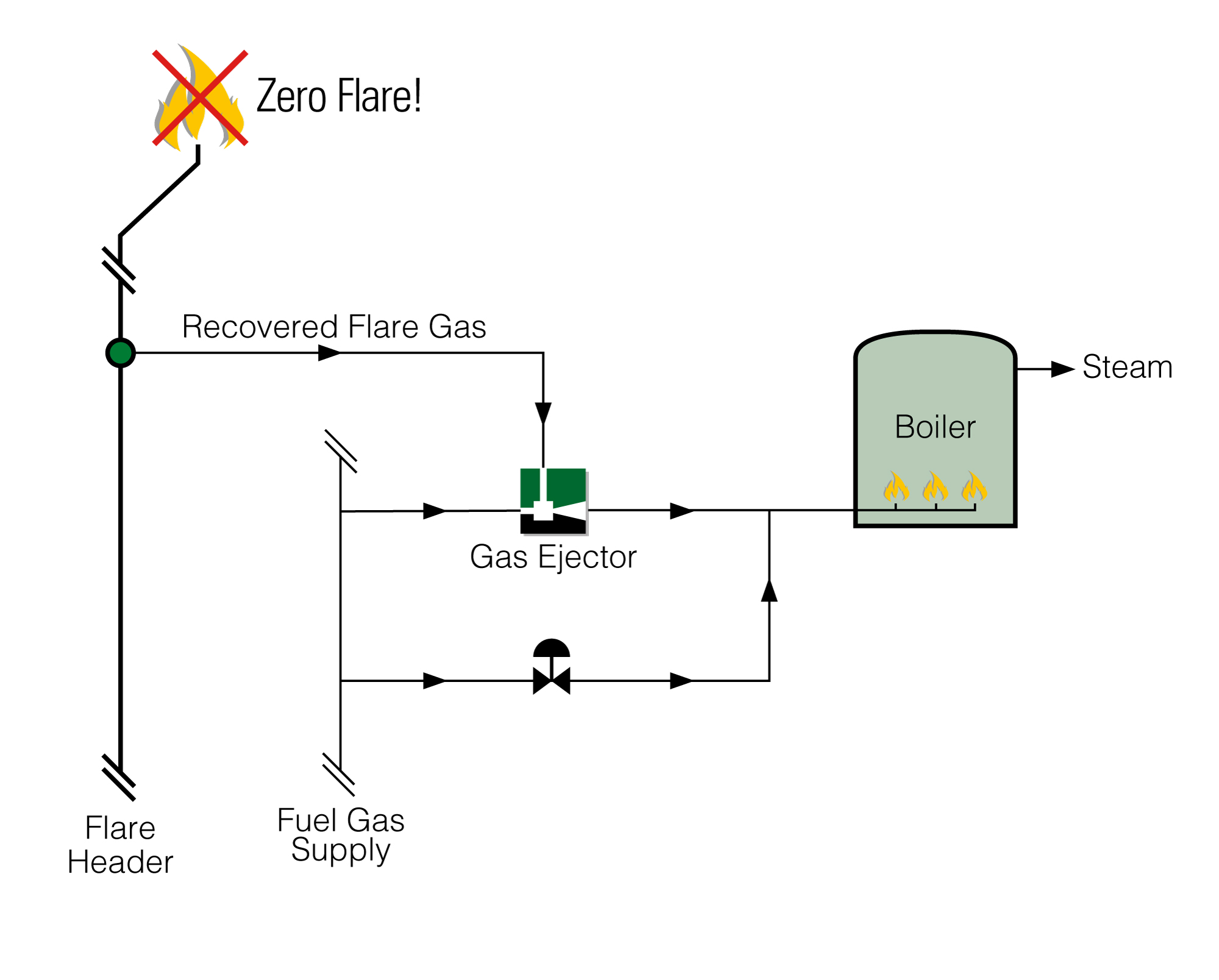
Various sources of high pressure motive gas can be used to drive a Flare Gas Recovery Ejector, including compressor discharge gas, high pressure export gas, or even gas from compressor recycle, which is usually wasted.
For projects where high-pressure gas is readily available, the use of Ejectors becomes highly favorable when compared with other technologies. As the Ejector discharge stream is only gas, no downstream separation is required, making it a very simple installation.
Option 2: Liquid Motivated Ejector Recirculation Systems
For projects that do not have the benefit of an existing suitable motive liquid stream, Transvac can provide its own through a packaged, closed-loop system, which incorporates a dedicated pump and separator.
This approach minimizes liquid (typically water) requirements as the liquid is re-circulated, making it ideal for regions where water is scarce, such as the Middle-East. The Ejector discharges into a small, dedicated separator to allow recovery of the boosted flare gas flow, and also return the liquid back to the suction of the dedicated pump.
Option 3: Liquid Motivated Ejectors Using Existing Pumps/Separators
Many established production and process facilities have high pressure liquid streams available, such as injection or produced water, and it makes good sense to utilize this. In many cases only a relatively small 'side-stream' flow can be used to drive a Flare Gas Recovery Ejector.
It is also common to utilize an existing separator for the two-phase Ejector discharge stream. Where space or weight constraints are a consideration, such as offshore platforms or already congested facilities, Ejectors offer a valuable practical benefit.
Special Applications
Using Amine as Motive Fluid
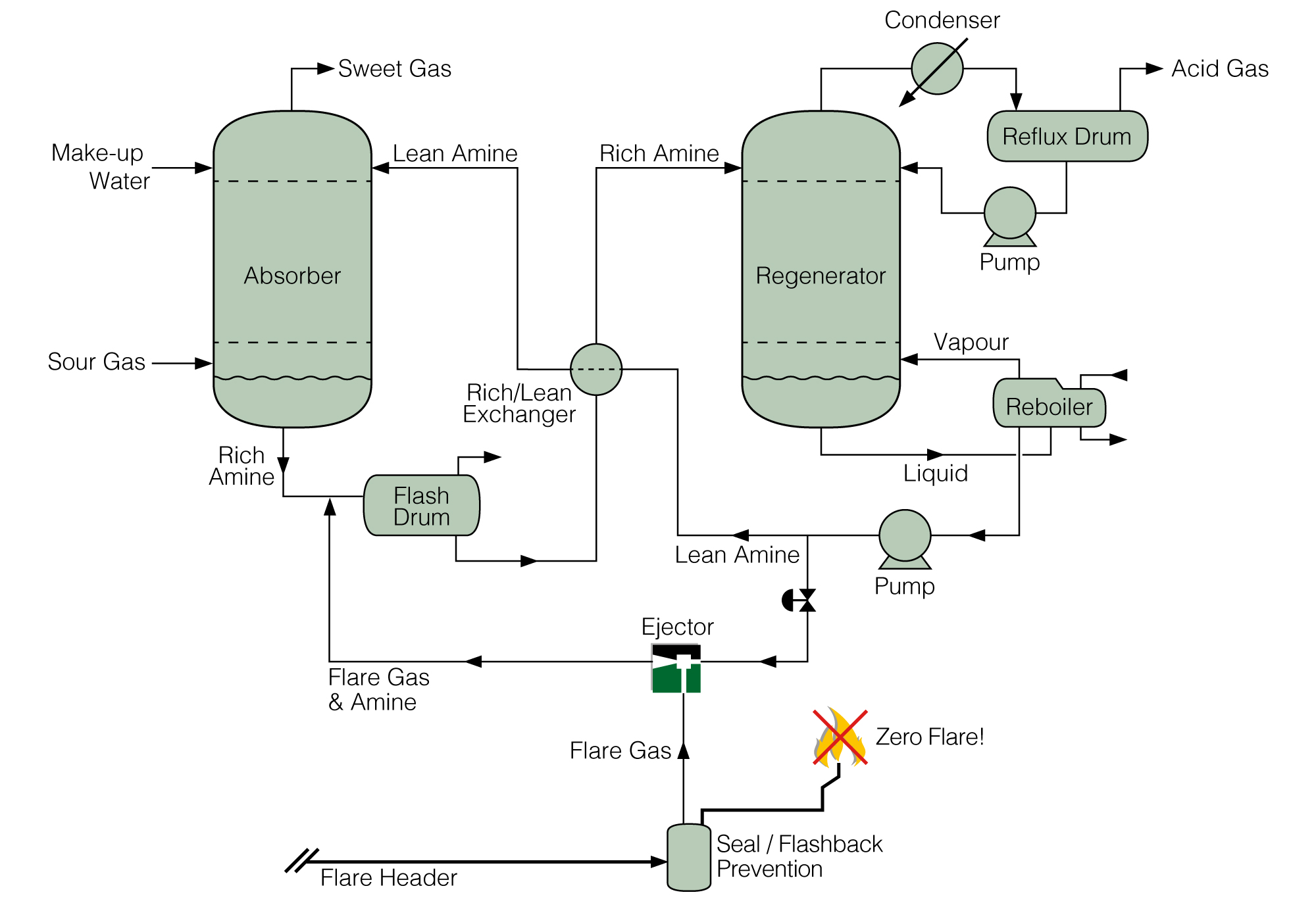
Aside from water streams, another suitable fluid is Amine. Lean or Rich Amine is often readily available at gas processing facilities where gas sweetening is carried out. The Amine recirculation pumps typically provide a sufficient motive stream to drive an Ejector.
Waste Gas Motivated FGR
Waste gas energy can be used to drive Ejectors. Gas energy that is normally wasted when an existing mechanical Compressor is in recycle can be used to drive a gas Ejector to entrain and recover flare gas. Globally there are 1000's of existing mechanical Compressors in recycle with waste energy available.
Product Literature & Resources
Technical Documents
Request for Quote
Request for Quote (RFQ) Form
Download and complete this form to submit your ejector requirements for quotation
Contact for More Information
ZIRCO is the authorized Western Canada representative for Transvac Flare Gas Recovery Ejectors. Contact our team for:
- Technical specifications and sizing
- Application engineering support
- Quotations and delivery information
- After-sales service and support
Ready to Eliminate Routine Flaring?
Contact our team today to discuss how Transvac Flare Gas Recovery Ejectors can help you achieve Zero Routine Flaring and Net Zero Carbon targets. ZIRCO provides expert support for Western Canada oil and gas operations.